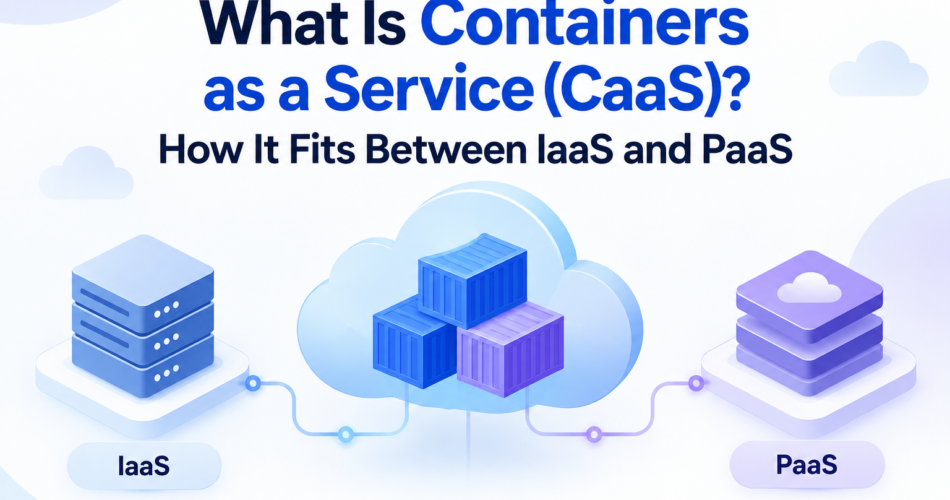
CaaS (Containers as a Service) is a cloud service that runs your container images for you. You still decide what goes inside the image. The provider takes on more of the machines, the scheduler, and the restart logic. That is why CaaS sits between IaaS, where you still own the operating system, and PaaS, where the platform often wants your source code more than your image.
That is the whole model. The rest of this page is what vendor glossaries leave out: what CaaS is not, who still gets paged, when it is a worse idea than a single VM, and how it quietly sits under a lot of SaaS products.
First, the other CaaS (so search does not waste your morning)
In cloud computing, CaaS means Containers as a Service. Older telecom slides still use CaaS for Communications as a Service: hosted voice, video, and messaging. Communications platforms today are more often sold as CPaaS or UCaaS. If you landed here from a networking brief, you want a different article. This one is about containers.
What you hand over, in one sentence
You hand over an OCI image (the format Docker and almost everyone else produce) plus a short wish list: CPU, memory, port, how many copies, what healthy means. The CaaS platform places that image on compute, connects it to a network, replaces crashed copies, and if you ask, adds more copies when traffic rises.
You do not hand over the application’s brain. A sloppy image on CaaS is still a sloppy image. The platform does not rewrite your Dockerfile.
The CLI test that ends the IaaS / CaaS / PaaS argument
Cloud pages love diagrams. Meetings need a test you can say out loud. Say which of these you are actually choosing.
IaaS
You are choosing instance size, AMI or image family, SSH access, and who patches the guest OS. Classic examples: Amazon EC2, Google Compute Engine, Azure Virtual Machines.
CaaS
You are choosing container CPU and memory. You may still see a cluster. You should not be building that cluster from empty VMs. Examples: Amazon ECS and EKS, Google Kubernetes Engine, Azure Kubernetes Service, AWS Fargate, Cloud Run, Azure Container Apps.
PaaS
You are choosing a language runtime or a git branch. The platform builds and runs. Examples: Heroku, Google App Engine, Azure App Service, many git push specialists.
FaaS
You are choosing a function and a trigger. No long-running process unless you stretch the model. Example: AWS Lambda.
SaaS
Your customer is choosing a plan. They never see a container.
If a salesperson says we are a platform and you still write Kubernetes manifests, you are on CaaS with extra vocabulary.
CaaS is not Docker, and it is not Kubernetes
This mix-up is why so many glossary pages read the same. Three different things share the word container in a meeting.
Docker
Docker and other container engines package and run a container on a machine. Docker is a tool. It is not a service. Installing Docker on one VM is not CaaS. It is IaaS with extra software.
Kubernetes
Kubernetes is an orchestrator. It schedules containers across machines, restarts them, and exposes them on a network. Kubernetes is also not a service until someone else runs the control plane and, often, the nodes.
CaaS as the hosted layer
CaaS is the commercial wrapping. A provider runs the host layer and enough of the orchestrator that your team can treat run this image as the main job.
How the pieces fit, in one list.
- Docker on your laptop = local engine
- Docker on an EC2 box you patch = IaaS plus containers
- EKS / GKE / AKS = CaaS with Kubernetes visible
- Fargate, Cloud Run, Azure Container Apps = CaaS with the nodes hidden
- OpenShift as a managed cloud service = CaaS with a larger platform on top of Kubernetes
Kubernetes and CaaS are not synonyms. Most CaaS products still use Kubernetes or a cousin under the floor.
How CaaS fits between IaaS and PaaS without the brochure sentence
IaaS gives you a computer in someone else’s building. You get flexibility that looks like the old data center: any OS, any agent, any leftover binary from 2014. You also get the chores of that data center: patching, capacity math, the disk that fills because nobody owned logs.
PaaS gives you a paved road for one kind of app. You move fast while your app looks like what the platform expected: one language, one process, one way to bind a port. You stall when you need a sidecar, a native library the buildpack hates, or three languages in one release train.
CaaS takes the unit that already solved works on my machine, the container image, and makes that the thing you deploy. You keep the inside of the image. You stop pretending that capacity planning for the host OS is a product feature.
CaaS fits microservices well because each image can carry its own runtime. The missing half of that story: a monolith in a container is a valid CaaS workload. You do not need twelve services to justify the model. You need a packaging unit you trust.
Managed Kubernetes sits closer to IaaS because you still see nodes. Serverless container products sit closer to PaaS because the node has left the chat. Both are CaaS because the artifact is still the image.
Who owns which 2 a.m. problem
Vendor pages list benefits. They skip the split that actually matters.
What you still own
Image contents, base packages, and app secrets you put in the image. Health checks that tell the truth. How services talk, and whether that chat is encrypted. Data in disks and databases attached to the app. RBAC inside your app.
What the CaaS provider usually owns
The physical facility, the hypervisor, and often the node OS. Placing containers on capacity. The base network fabric. Restarting dead tasks or pods. RBAC on the platform.
What nobody should assume
That managed means your Dockerfile is safe. That idle managed nodes are free. That moving images equals moving IAM and ingress. That stateful disks behave like stateless replicas. That app RBAC and platform RBAC are the same list of people.
Read that last group twice. That is where CaaS projects go quiet after month three.
A single service, from laptop to CaaS
A payments API lives in a repo. CI builds an image, scans it, and pushes registry.example.com/payments:git-sha. Staging pulls that tag. Production pulls the same tag after a human or a pipeline says yes.
The same app on IaaS
Someone also maintains the VM image, the Docker version on that VM, the process manager, and the night the certificate expires.
The same app on CaaS
The pipeline calls an API: run this tag, 0.5 vCPU, 1 GB RAM, two copies, probe /health. The platform finds capacity. If a copy dies, another copy appears. If traffic doubles, a rule adds copies, or you raise the number yourself.
The same app on PaaS
The pipeline might send the repo, not the image. The platform builds. That is faster until the build is not your build.
Notice what did not change in the CaaS version: the image is the contract between laptop, staging, and production. Portability is not a slogan. It is the same tag ran in three places.
What actually belongs on CaaS
Not every workload needs this model. These usually do.
HTTP APIs and websites
These already ship as images. This is the default.
Queue workers
They should exist when the queue is deep and disappear when it is not. Serverless container products are built for this shape. A cluster you sized for Friday traffic and left on all weekend is not.
Batch jobs
They have a start and an exit code. Render a PDF. Transcode a file. Fold the job into a scheduled container instead of a VM that waits.
Mixed runtimes
Go service, Python worker, leftover JVM. PaaS buildpacks get tribal. Images do not.
Preview environments
One service per pull request. Product teams review a feature without sharing staging with six other branches.
The guts of a SaaS company
Users buy Software as a Service. The company often runs that software as a dozen containers. CaaS is not the product. It is how the product stays shippable.
When CaaS is the wrong buy
Pages that only sell the model get the click and lose the trust.
One app, one developer, one deadline
Use a simple PaaS or a managed VM. Learning images, registries, probes, and IAM in the same week as the launch is how launches slip.
The hardware is the product
Custom kernel modules, odd GPUs the provider does not expose, or keys bolted to a chassis. That is still IaaS or bare metal.
You wanted Kubernetes on a slide
A managed cluster with default namespaces, no resource quotas, and latest tags in production is not modernization. It is a faster way to replicate a mess.
You thought CaaS meant git push and sleep
Some products are close. Many still want manifests, ready probes that are not the same as live probes, and a person who understands why a copy is CrashLooping.
The workload is a database you pretend is stateless
You can attach disks. You now own backup, failover, and the day the disk is in the wrong zone. Managed databases exist for a reason. CaaS next to a managed database is a common, boring, correct design.
What the big clouds named it
Do not memorize product names as if they were the definition. Memorize the split: cluster you can see vs container you just run.
Amazon
ECS is Amazon’s scheduler. EKS is Kubernetes with a managed control plane. Fargate removes the EC2 instances under either of those.
GKE is Kubernetes. Cloud Run is here is an image, give me HTTPS, which is CaaS leaning toward PaaS.
Microsoft
AKS is Kubernetes. Azure Container Apps is the app-centric middle. Azure Container Instances is run this container for a while.
Red Hat, IBM, and similar platforms
OpenShift and managed Kubernetes services add policy, builds, and routes, still with the image as the unit.
Smaller platforms
Render, Fly.io, Railway, and managed Docker hosts blur CaaS and PaaS on purpose. If you deploy a Dockerfile or an image and you do not patch the host, you are in this neighborhood even when the homepage says platform.
Cost: the three surprises after the free-tier screenshot
Pay only for what you use appears on every glossary page. Then finance Slack lights up.
Empty nodes are not empty invoices
On managed Kubernetes you still size a pool. Autoscaling helps. It does not always scale to zero overnight.
Serverless containers move the cost, they do not delete it
You pay when the container runs. You also pay for cold starts, request-priced networking, and the extra copies you added because p95 latency looked ugly.
The image was cheap. The conversation was not
Load balancers, egress between services, and persistent volumes regularly outrun vCPU on microservice graphs.
Price the same API three ways against last month’s real request count: a pair of VMs, a small managed cluster, and a serverless container product. Use your traffic shape, not a conference average. That spreadsheet beats another benefits list.
Lock-in is in the glue. Images move. Ingress annotations, vendor schedulers, and IAM condition keys do not. CaaS is more portable than a snowflake VM. It is not a multi-cloud holiday.
Security is split whether the datasheet says so or not
The platform can isolate tenants, patch a host, and offer a scanner. It cannot stop you from shipping a root user, a shell, and last quarter’s production token in layer 7.
These checks show up in real incidents.
Scan in CI
CI fails the build on known criticals in the image you are about to run.
Keep the base image thin
Base images are thin and dated on a calendar, not on a wish.
Give each service its own identity
Each service has its own identity. The cluster role is not an identity.
Treat the registry as production
The registry is production. Untagged latest in prod is a rumor, not a release.
CaaS makes a bad image travel farther, faster. Isolation between containers is real. It is not a substitute for what you put in the filesystem.
If you buy software, why this page still matters
Most people comparing tools do not want a lecture on schedulers. Two reasons to care anyway.
When you buy software
You are buying SaaS. The vendor’s CaaS choices stay invisible until a region dies or preview apps take twelve minutes to boot. Do you deploy as containers, and can one region fail without taking the rest? That is a better question than which cloud.
When you build software to sell as a subscription
CaaS is one of the ways you get multi-instance, multi-region updates without an installer on the customer’s laptop. That loop, image in and subscription product out, is the business case. The glossary case is just the stack diagram.
A decision you can finish in one document
Skip the architecture review that starts with should we do Kubernetes. Answer these in writing.
What do we already ship?
An image tag, a VM image, or a git repo the platform builds?
How many long-running processes are there?
One website can live anywhere. Several services plus workers start to justify CaaS.
Who is on call for the node?
If the answer is nobody with that in their title, hide the nodes (Fargate, Cloud Run, Container Apps) or stay on PaaS.
What must be allowed to leave this cloud later?
If the answer is the workload, stay close to the image and keep glue thin.
If the answers point at CaaS, move one non-critical API first. Measure deploy time, recover-from-death time, and the bill. Then move the next service. Migrations that start with a manifesto stall. Migrations that start with one tag in production finish.
CaaS FAQ
Short answers for the questions people type after the definition.
What does CaaS stand for?
Containers as a Service. In older comms material it can mean Communications as a Service. In cloud infrastructure writing, it means containers.
Is Kubernetes CaaS?
Kubernetes is software. Managed Kubernetes (EKS, GKE, AKS, managed OpenShift) is CaaS. Running Kubernetes yourself on rented VMs is IaaS plus a lot of homework.
Is Docker CaaS?
No. Docker builds and runs containers. CaaS is a hosted environment that runs the images those tools produce.
How is CaaS different from PaaS?
CaaS deploys an image you built. PaaS often deploys source code onto a stack the vendor chose. CaaS gives more control inside the process. PaaS gives less surface area if your app is ordinary.
How is CaaS different from IaaS?
On IaaS you still raise and patch the machine. On CaaS the unit you scale is the container, and the provider owns more of the host.
How is CaaS different from SaaS?
SaaS is what a customer subscribes to. CaaS is one way a vendor runs the software behind that subscription.
What is an example of CaaS?
AWS Fargate running an ECS task from your image. Cloud Run serving a container on a URL. Azure Container Apps scaling replicas from an image in a registry. GKE running the same image when you want Kubernetes APIs.
Does CaaS replace DevOps?
It removes some host chores. It does not remove CI, image hygiene, identity, or on-call for the application.
Can CaaS run on-premises?
Yes. Some vendors sell the same model in your data center or in a hosted private region. The idea does not require a public cloud. It requires someone other than the app team to run the container platform.
Before you close the tab
CaaS is not a promotion from IaaS and not a demotion from PaaS. It is a trade: you agree to ship software as images, and in return you stop treating servers as the main object in the sprint.
IaaS still wins when the machine shape is the point. PaaS still wins when the team should only think about code. SaaS is what users buy. CaaS is what a lot of teams use so those users never have to care.
If the next meeting starts with a logo, change the question. Ask what you are trying to stop owning. The answer will tell you whether CaaS belongs in the middle of the stack, or whether you are about to rent a more expensive way to run the same old VM.
Comments