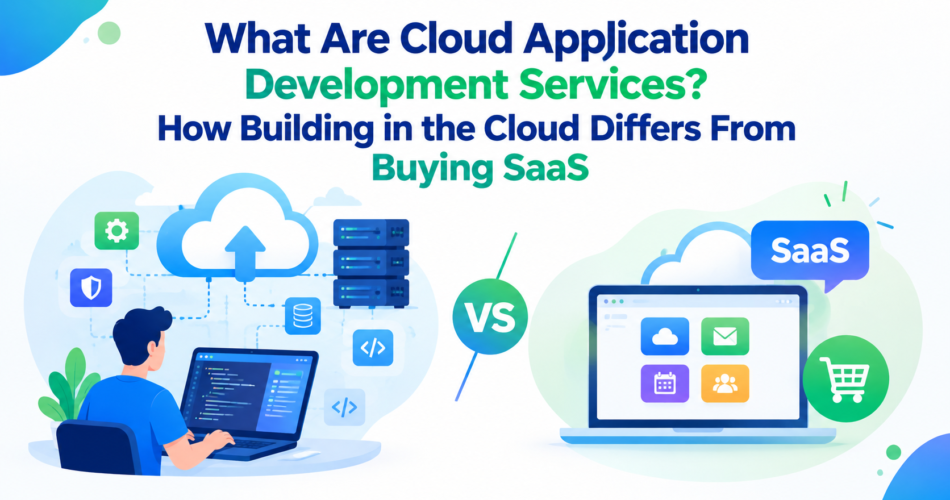
Cloud application development services are hired to design, build, and run software that lives on public or private cloud infrastructure. You do not get a finished product with a pricing page. You get an application, plus the environments and permissions that keep it reachable after the build team logs off.
People hear cloud and picture a subscription tool. That is a different buy. A subscription tool is software someone else has already finished and rents to you. This phrase is the labor that puts your application onto cloud machines, containers, or a platform so your users can reach it through a browser or an API.
Three Words, Three Commitments
Cloud means the app does not live on a tower under someone’s desk. Compute, storage, and networking come from a provider such as AWS, Google Cloud, or Azure, or from a private cloud that behaves like one. Someone still has to choose regions, accounts, and who can click destroy.
Application means this is not a slide about migration. It is software with users, data, and a job: a portal, an API, an internal ops tool, a customer workspace. If the engagement only moves files to object storage, you hired a move, not application work.
Development services means you are paying people. Discovery, interface, backend, cloud wiring, tests, a deploy path, and usually a period of care after go-live. The phrase is a staffed engagement. It is not a SKU product.
When a vendor collapses those three into a cloud, ask which commitment they are actually taking.
Two Invoices That Get Presented as Twins
Renting finished software looks like this. You pay per seat or per usage. The vendor owns the app and the lights. You configure. You export what they allow. You do not choose the database.
Hiring cloud application development services looks like this. You pay for construction. The app should end up in an account you control. The roadmap is yours even when they recommend cutting a feature. If you later charge strangers a monthly fee to use that app, you became the vendor. They were the crew.
One sentence separates them. If strangers pay you every month to use the software, you are selling a product. If you pay a team so that software can run on cloud infrastructure, you hired cloud application development services.
What Teams Actually Ask These Services to Build
Not every request deserves a custom cloud app. These usually do.
- A customer or partner portal that must sit on your data, not on a generic site builder.
- An API other systems will call, with keys, limits, and an audit trail.
- An internal tool whose rules are the business: dispatch, claims, intake, pricing that no catalog product models without a pile of workarounds.
- A first version of a product you intend to charge for, knowing that billing and shared accounts have to be real, not painted on.
The output can be public or private. A company-only tool, a partner integration, and a regulated workflow with no marketing site still count. Selling subscriptions is optional. Running on cloud infrastructure is not.
What the Phrase Is Not
Lift and shift by itself is not this work. Copying a server image into a virtual machine in a cloud region can be useful. The app is still the same old app with a new landlord.
Opening a cloud account is not this work. Anyone can open AWS. Development services start when someone shapes the app and the path that takes a change from a laptop to production without a hero on Friday night.
Picking IaaS, PaaS, or Containers is not the service either. Those labels describe how the app is hosted. IaaS is machines. PaaS is a paved platform. Containers make the image the unit you run. A competent team can explain which one they chose and who pays the bill. The label is not what you hired. The work is.
Environments Tell the Truth Faster Than a Roadmap Slide
Ask where code goes on an ordinary Tuesday.
Developers need a place to break things that is not production. If they test by editing the live app, you do not have a cloud practice. You have courage.
Staging should look like production: same kind of database, same kind of auth, fake or masked data. Demos from a laptop convince rooms. They do not convince traffic.
Production should be a place you can leave. Deploy should be a repeatable action. Credentials should live in your vault. If only one contractor can release, the application is rented from that person, even when the cloud logo is famous.
If a proposal never mentions these three rooms, the application will still need them. You will pay for them later, in a hurry.
Ownership Is a Setting, Not a Promise
Cloud application work creates more than screens. It creates accounts and projects at the cloud provider, networks and firewall rules, databases and backups, pipelines that build and ship, and logs you will need on a bad day.
All of that should sit under your organization, with their access granted and revocable. When it sits under theirs, going away is a migration project you did not budget.
The same rule applies to source. A repository you cannot open today is not yours yet, no matter what the contract recites about intellectual property after final payment.
When the Hire Makes Sense, and When It Does Not
The hire is reasonable when your workflow is specific enough that configuring a popular tool would mean fighting the tool. It is reasonable when you already have data and users and need a durable way for them to reach each other over the internet, with login, roles, and backups handled. It is reasonable after a no-code layer hits a wall the vendor will not cross. It is reasonable when you can name one person who will accept or reject work. Services amplify that person. They do not replace them.
The phrase is covering a worse plan when nobody has watched a user do the job in the last month. You would be paying for guesses hosted at scale. It is a worse plan when a standard product already does the job. Pay for that product and for someone to set it up. Keep the build budget for the part no catalog screen understands.
It is also a worse plan when the deadline is a ceremony. Cloud apps that must be perfect on a stage date become demos. Demos are allowed. Calling them production is how outages get an audience. And we are in the cloud is not a benefit by itself. A slow, fragile app in a region closer to your users is still slow and fragile.
Cost, First Slice, and the Estimate Call
A small portal on one cloud, one region, one kind of user, can sit in the tens of thousands if the job is narrow and the team is senior enough to stop early. Add roles, two integrations, audit logs, and a mobile client, and the same conversation becomes six figures before anyone is theatrical about it.
Monthly cloud spend is separate. Idle environments, chatty logs, and a database left at a size chosen on a hopeful afternoon will outgrow the application fee in quiet ways. A bid that undercuts every other bid by half is usually a different application: fewer environments, shared accounts, or a plan to recover margin in change requests. Ask which of those it is. Then decide.
Start with one job. A broker uploads a file and the other party can see the status. A supervisor approves a request that already exists on paper. Keep the rest of the company on current tools until that job survives contact with real people. Write that job in the statement of work as a completed action, not as a list of modules. Modules hide. Completed actions get argued about in the open, which is the point.
Put the cloud bill in your account from week one, even if it is small. Surprise spend is easier to see when the invoice has your name on it. Agree what happens after go-live in hours per month, not in we are here if you need us. Need arrives at night.
On the estimate call, listen for region, backup, and who gets the alert when the app stops answering. Listen for names of the people who will do the work. Listen for a refusal: we will not put production data on a shared demo cluster.
If every answer is whatever you prefer, you are the architect and they are typing. That can work when you already know the system. It fails when you hired them because you do not.
A short paid discovery that ends with buy this product or build this one path is cheaper than a year of modules. After that, the only comparison that matters is whether a real user finished the job on the cloud app without calling the person who built it.
Comments